
7 Ways the ESV Journaling PDF Files Can Improve Your Bible Study
/
There are piles of Bible study tools available. Some are wonderful. Some are unnecessary. Some are junk. And some seem designed mainly to help us avoid actually reading the Bible.
But every so often, a simple tool comes along that really does help. I’m thrilled about just such a tool.
Crossway’s ESV Bible, Portrait Journaling Edition PDF Download is one of those tools.
This is not complicated. That is part of the beauty of it. You purchase the PDF download, and then you receive the complete Bible text separated into 66 PDF files, one for each book of the Bible. So instead of carrying around an entire journaling Bible or trying to squeeze notes into the tiny margin of a regular Bible, you can print the book of the Bible you are studying and mark it up. And maybe keep it forever or only use it temporarily.
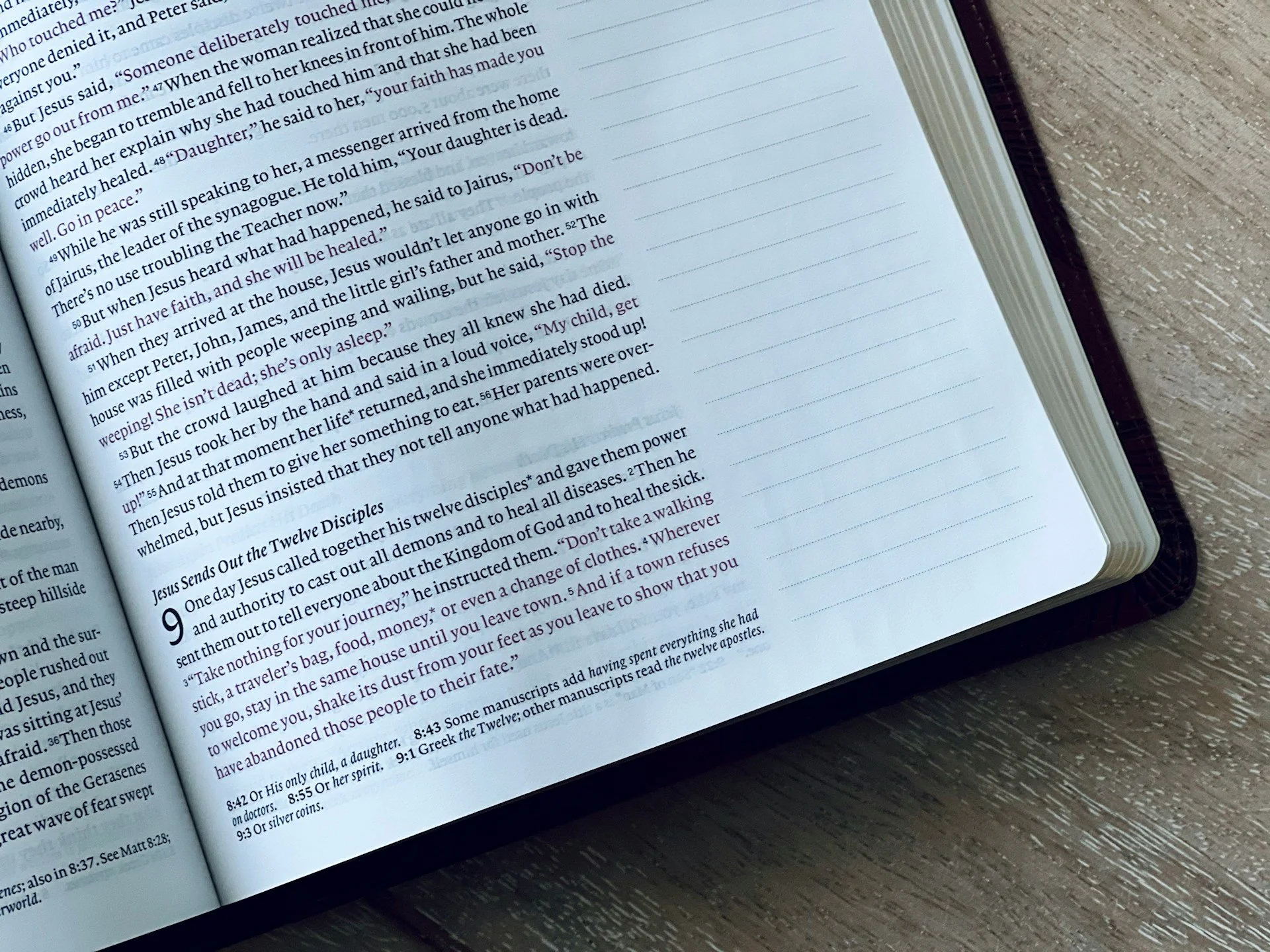
I’ve found that the PDF edition allows users to download, print, and journal alongside chosen portions of Scripture. The portrait edition uses an 8.5" x 11" layout, 9.5-point type, and ruled margins beside the biblical text. It is designed for personal devotions, small-group study, Sunday School preparation, and sermon preparation.
That is exactly why I like it!
I have used journaling Bibles for years. I love them. I write in them. I underline. I circle. I draw lines. I add all kinds of notes. But there are times when I want to work through a passage for a specific purpose without making those notes permanent in my other journaling Bibles. A printed PDF gives me that freedom.
With all that in mind, here are seven ways this tool can help improve your Bible study.
1. Print only the book or passage you are studying
One of the best features is also the simplest. The download contains a folder with 66 PDF files. Each file is a book of the Bible.
So, if you are studying 1 John, you open the 1 John PDF and print it. If you are working through Philippians with a small group, print Philippians. If you are preparing to teach Jonah, print Jonah. There is no need to print the whole Bible, buy another bound volume, or haul around more paper than necessary.
This makes Bible study feel more focused. You are not staring at everything at once. You are working through the actual book in front of you.
2. Mark it up without hesitation
A printed copy gives you permission to be messy.
Circle repeated words. Underline key phrases. Draw arrows. Box commands. Highlight contrasts. Write questions in the margin. Put a large question mark next to something you need to study later. Track themes. Mark structure. Note Old Testament echoes. Write down cross-references.
You can do all of that in a Bible, too, of course. But sometimes I hesitate because I do not want to clutter the page forever. A printout removes that pressure.
This is especially useful when you are still early in the study process. Some early notes are gold. Some are not. They looked useful at first, but after a closer look, they need to go. That is fine. Print another copy.
3. Use it for sermon or teaching preparation
For preachers and Bible teachers, this is outstanding.
Print the book or passage you are teaching and carry it with you. Work through the text slowly. Mark the flow of thought. Identify the author’s argument. Note transitions. Write down illustrations, questions, applications, and connections to the gospel.
If you are preaching through a book, you can divide the printed pages according to sermon units. You can mark where one sermon ends and another begins. You can track repeated themes across the book. You can keep your notes tied directly to the text instead of scattered across notebooks, apps, napkins, and the foggy recesses of your memory.
The page keeps asking the right question: What does the text say? And that question is far better than “What clever thing can I say this week?”
4. Bring it to a small group Bible study
This may be one of the most practical uses.
Bring a printed passage to a small group and write down what others in your group observe. Note questions that come up. Record the applications people share. Write down prayer requests right there in your Scriptures for that particular small group. Add names. Capture the way the Spirit is using the Word among real people in the room. And it’s okay, because you won’t likely keep these pages forever. (If there’s something really good, see idea 7 below.)
Those notes may not belong in your primary Bible forever. But they do belong somewhere. The printed PDF gives you a place to put them right next to the passage being studied.
That matters because Bible study is not merely information transfer. We are not trying to win Bible trivia night. We are seeking to hear God’s Word, understand it rightly, believe it, obey it, and help one another do the same.
5. Create a study binder for a book of the Bible
After printing a biblical book, you can staple it, clip it, or put it in a binder. A binder gives you room to add other material, too.
You might include:
Your printed ESV journaling pages
Sermon notes
Study questions
Word studies
Maps or charts
Prayer requests
Reflections after teaching or discussion
Over time, you build a record of your study through that book. This can become especially useful if you later teach the same book again. You will not be starting from nothing. You will be starting from your previous labor in the Word.
That said, do not let the binder become the point. The goal is to know, live, and proclaim God’s Word.
6. Study with a specific purpose in mind
Sometimes you read a biblical book devotionally. Sometimes you study it for preaching. Sometimes you study it with a small group. Sometimes you are tracing a theme, preparing a class, counseling someone, or working through a theological question.
The same passage may need different kinds of notes for different purposes.
A printed PDF allows you to make a copy for one specific study. You might print Ephesians and trace every reference to the church. You might print Mark and mark every question Jesus asks. You might print Genesis and trace creation, promise, covenant, and blessing. You might print 1 Peter and look for how suffering and hope are held together.
This keeps your study active. You are not just reading words on a page. You are observing, asking, marking, connecting, and thinking. That is not a gimmick. That is part of careful Bible study.
7. Transfer the best notes into your Bible later
The printed pages can function like a workshop.
Work there first. Make the mess there. Sort out your thoughts there. Then, after you have studied, prayed, discussed, taught, or preached the passage, transfer the most helpful notes into your Bible or a permanent notebook.
This helps keep your Bible from becoming cluttered with half-formed thoughts while still preserving the insights worth keeping.
It also encourages patience. Bible study often gets better after a second pass. The first pass raises questions. The second pass begins to see structure. The third pass starts to notice what was obvious all along, which is humbling but good for the soul.
A few practical reminders
Remember that this tool will not study the Bible for you. It gives you room to work. You still have to do the work.
Print the passage. Read it slowly. Pray. Observe. Ask good questions. Look at the context. Trace the argument. Consider how the passage points us to Christ. Apply it honestly. Then obey.
The tool is useful because it gets you closer to the text, not farther from it.
Final thoughts
I really like these ESV Journaling PDF files. A lot. They are simple, affordable, printable, and genuinely useful. For pastors, teachers, small-group leaders, and everyday Christians who want to grow in Bible study, this is money well spent.
You get the Bible divided into 66 printable PDF files. You can print one book, one section, or one passage. You can write all over it. You can carry it around. You can put it in a binder. You can use it for personal devotions, sermon prep, small-group study, or one-off projects. It’s tangible paper, and it works well for all of this.
Anything that helps Christians spend more careful time in the Bible is worth considering. And this does that.